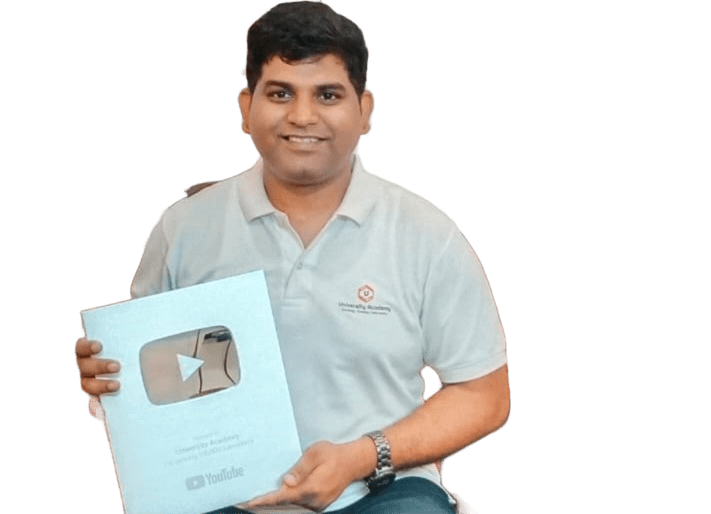
Sandeep Kumar Vishwakarma
Research Scholar
J.C. Bose University of Science and Technology, YMCA (Formerly YMCA UST)Research Areas
Image & Video Dehazing
Image and Video Dehazing is my principal research specialization, focusing on the development of intelligent computational techniques to restore visibility and improve the quality of images and videos captured under adverse weather conditions such as haze, fog, mist, smoke, dust, and atmospheric pollution. The primary objective of my research is to recover clear visual information while preserving fine details, accurate color representation, and structural integrity. My research integrates Machine Learning, Deep Learning, Computer Vision, and Artificial Intelligence to develop advanced dehazing frameworks capable of handling diverse environmental conditions. I investigate state-of-the-art architectures including Convolutional Neural Networks (CNNs), Vision Transformers (ViTs), Attention Mechanisms, Variational Autoencoders (VAEs), Generative Adversarial Networks (GANs), and Transformer-based Networks to improve image restoration performance.
Key Work & Outcomes
- Developed novel deep learning frameworks for image and video dehazing.
- Conducted extensive research on haze removal using CNNs, Vision Transformers, and attention-based neural networks.
- Proposed efficient AI models for restoring degraded outdoor, satellite, underwater, and surveillance imagery.
- Improved visibility, structural similarity, and perceptual image quality using advanced deep learning techniques.
- Enhanced the performance of downstream computer vision tasks, including object detection and scene understanding, through effective image restoration.
- Published multiple research papers in Scopus and Web of Science indexed journals focusing on image restoration and computer vision.
Compiler Design
Compiler Design is one of my academic and research interest areas, focusing on the principles, design, and implementation of compilers that translate high-level programming languages into efficient machine-executable code. My work emphasizes understanding the complete compilation process, including lexical analysis, syntax analysis, semantic analysis, intermediate code generation, code optimization, and target code generation. My research and teaching explore modern compiler construction techniques, parser generation, optimization strategies, and runtime environments for programming languages. I investigate methods to improve compiler efficiency, reduce execution time, optimize memory utilization, and enhance code quality while maintaining correctness and portability.
Key Work & Outcomes
- Strong academic foundation in compiler construction and programming language implementation.
- Expertise in compiler phases, parsing techniques, semantic analysis, and code generation.
- Experience in designing lexical analyzers and parsers using Lex/Flex and Yacc/Bison.
- Research interest in intelligent compiler optimization using Artificial Intelligence and Machine Learning.
- Applied compiler optimization techniques to improve execution speed, memory efficiency, and code quality.
- Extensive teaching experience in Compiler Design for undergraduate engineering students.
- Integrated theoretical compiler concepts with practical implementation through laboratory exercises and programming projects.
Data Structures
Data Structures is one of my core academic and research interest areas, focusing on the design, implementation, and optimization of efficient data organization techniques that enable high-performance computing and intelligent software development. My work emphasizes selecting and designing appropriate data structures to efficiently store, retrieve, manipulate, and manage large volumes of data while optimizing computational performance. My research and teaching cover both linear and non-linear data structures, including arrays, linked lists, stacks, queues, trees, graphs, heaps, hash tables, and advanced data organization techniques. I investigate how different data structures influence algorithm efficiency, memory utilization, and system scalability, particularly in modern computing applications. A significant aspect of my work involves integrating data structures with algorithm design, artificial intelligence, machine learning, computer vision, database systems, and big data analytics. Efficient data organization is fundamental to developing intelligent systems capable of processing massive datasets with high speed and reliability.
Key Work & Outcomes
- Strong expertise in designing and implementing efficient data structures for solving computational problems.
- Extensive experience in analyzing the performance of data structures using time and space complexity.
- Integrated data structures with advanced algorithms to develop scalable and high-performance software solutions.
- Applied graph, tree, and hashing techniques in artificial intelligence, machine learning, and computer vision applications.
- Experienced in implementing data structures using Python, C, C++, and Java.
Machine Learning
My research area is Machine Learning, with a focus on developing intelligent algorithms for data analysis, pattern recognition, predictive modeling, and real-world problem solving. My research interests include Deep Learning, Computer Vision, Natural Language Processing (NLP), Artificial Intelligence, Image and Video Processing, and the application of machine learning techniques to solve complex engineering challenges.
Key Work & Outcomes
- Published research papers in reputed Scopus and Web of Science indexed journals.
- Conducted research in Machine Learning, Deep Learning, Computer Vision, and Natural Language Processing (NLP).
- Developed intelligent models for image enhancement, object detection, and pattern recognition.
- Applied machine learning techniques to solve real-world engineering and computer vision problems.
- Experienced in Python, TensorFlow, PyTorch, OpenCV, and Google Colab for AI model development.
- Strong academic, research, and technical writing skills with experience in journal publications and conference presentations.
- Committed to advancing AI-driven solutions through innovative research and practical applications.
Deep Learning
My research in Deep Learning involves designing and implementing advanced neural network architectures for solving challenging problems in computer vision and artificial intelligence. I work with Convolutional Neural Networks (CNNs), Recurrent Neural Networks (RNNs), Vision Transformers (ViTs), Autoencoders, Generative Adversarial Networks (GANs), and attention-based models. My focus is on developing robust and computationally efficient deep learning frameworks for image restoration, video enhancement, object recognition, and intelligent perception systems.
Key Work & Outcomes
- Developed advanced deep learning frameworks for image and video restoration.
- Conducted research on transformer-based architectures for computer vision applications.
- Designed intelligent deep learning models for image and video dehazing.
- Applied CNNs, VAEs, GANs, and Vision Transformers to solve challenging image enhancement problems.
- Published research in reputed Scopus and Web of Science indexed journals.
Design and Analysis of Algorithms (DAA)
Design and Analysis of Algorithms (DAA) is one of my core academic and research interest areas, focusing on the systematic design, optimization, and evaluation of efficient algorithms for solving computationally intensive problems. My work emphasizes developing algorithms that are correct, scalable, and resource-efficient while minimizing execution time and memory consumption. My research explores fundamental algorithmic paradigms such as Divide and Conquer, Greedy Algorithms, Dynamic Programming, Backtracking, Branch and Bound, Randomized Algorithms, and Approximation Algorithms. I investigate methods for solving complex optimization, graph-theoretic, scheduling, searching, sorting, and combinatorial problems that arise in computer science and engineering. A major focus of my work is analyzing algorithm efficiency using asymptotic analysis, time complexity, space complexity, and computational complexity theory. I study algorithm performance under different computational models and optimize solutions for large-scale datasets, real-time systems, cloud computing, artificial intelligence, machine learning, and high-performance computing applications.
Key Work & Outcomes
- Strong expertise in designing efficient and scalable algorithms for solving complex computational problems.
- Extensive experience in analyzing algorithm performance using time and space complexity measures.
- Applied algorithmic techniques to optimization, graph theory, artificial intelligence, and machine learning applications.
- Proficient in implementing classical and advanced algorithms using Python, C, C++, and Java.
- Research interest in algorithm optimization for intelligent systems, data-intensive applications, and high-performance computing.
Funded Research Projects
| Project Title | Funding Agency | Duration | Role |
|---|---|---|---|
| Model Based Development of Domain ECU (DCU) and Validation through Hardware in Loop (HiL) Simulation for Commercial Vehicle Applications | DST | 2021 – 2026 | Dr. Albert Sunny |